CARD PAYMENTS FOR IRISH BUSINESSES

Compare Card Payment Providers in Ireland

Compare card payment providers, understand fees and payment options, and find a solution that suits the way your business takes payments.

Compare card payment providers

Choosing how your business gets paid

Card payment providers vary more than their headline rates suggest. The right choice depends on where your customers pay, how much they typically spend, how often you sell, and which software you already use. Stuama.ie sets out the main options for businesses in Ireland, what they cost and how they differ, so you can compare providers on the details that matter before you sign up. If you are setting up for the first time, our step-by-step guide on how to accept card payments in Ireland walks through the whole process.

This page is general information, not personalised financial advice. Always check a provider's current terms before you apply.

Most businesses need one or more of these

  • In-person card payments at a counter, table or till
  • Online card payments through a website checkout
  • Payment links sent by email, text or messaging app
  • Portable or mobile terminals for payments on the move
  • Integrations with your website, till or accounting software

Compare card payment providers

Three widely used providers that offer card payments to businesses in Ireland, compared on their published standard terms. Providers are listed alphabetically. Stuama.ie is not a partner of any provider listed, and inclusion is not a recommendation.

  • Revolut Business

    In-person and online card payments, using a Revolut terminal or Tap to Pay on iPhone.

    In-person payments
    • EEA consumer cards: 0.8% + €0.02
    • American Express: 1.7% + €0.02
    • Other cards: 2.6% + €0.02
    Online payments
    • EEA consumer cards: 1% + €0.20
    • American Express: 1.7% + €0.20
    • Other cards: 2.8% + €0.20
    Card readers and terminals
    • Revolut Terminal: €189 + VAT
    • Lite Terminal: €139 + VAT
    • Tap to Pay on iPhone: no hardware cost
    Monthly or platform charges
    Revolut Business account plans from €10 a month (Basic plan).
    Payouts
    Settlement generally within 24 hours, including weekends.Subject to the payment-processing agreement.

    View Revolut Business pricing (external site)

  • Square

    In-person and online payments with a €0 core point-of-sale subscription and a range of readers and terminals.

    In-person payments
    • EU/EEA cards: 1.75% + VAT
    • Manual card entry: 2% + VAT
    Online payments
    • EU/EEA cards: 1.4% + €0.25 + VAT
    • UK and non-EEA cards: 2.9% + €0.25 + VAT
    • Invoices, Virtual Terminal and Card on File: 2.5% + VAT
    Card readers and terminals
    • Square Reader: €19 + VAT
    • Square Terminal: €169 + VAT
    • Square Handheld: €199 + VAT
    • Square Register: €699 + VAT
    Standard prices; promotional discounts are sometimes offered.
    Monthly or platform charges
    €0 core POS subscription. No account activation, early termination, chargeback, inactivity or PCI-compliance fees on standard pricing.
    Payouts
    Standard transfers as soon as the next working day.

    View Square pricing (external site)

  • Stripe

    Online and in-person payments with no setup or monthly fee on standard pricing.

    In-person payments
    • EEA cards: 1.4% + €0.10
    • Non-EEA cards: 2.9% + €0.10
    • Tap to Pay: extra €0.10 per authorisation
    Online payments
    • Standard EEA cards: 1.5% + €0.25
    • Premium EEA cards: 2.8% + €0.25
    • UK cards: 2.5% + €0.25
    • Other international cards: 3.15% + €0.25
    Plus 2% where currency conversion is required.
    Card readers and terminals
    • BBPOS WisePad 3: €59
    • Stripe Reader S700/S710: €259
    • T600: €289
    Prices exclude VAT.
    Monthly or platform charges
    No setup or monthly fee on standard pricing.
    Payouts
    Standard payouts on a rolling, weekly or monthly schedule. Instant Payouts: 1% (minimum €0.50).

    View Stripe pricing (external site)

Prices are each provider's published standard rates for businesses in Ireland, checked on 28 September 2026. Rates can change, and some providers offer custom pricing to larger businesses. VAT may apply to fees. Check the provider's own site for current terms before you apply.

How to choose a card payment provider

Start with how your customers pay you today, then compare providers on total cost and on the practical details that affect your cash flow and day-to-day admin.

Transaction fees

Most providers charge a percentage of each sale. Check whether the rate differs for in-person, online and keyed-in payments, and for cards issued outside the EEA or business cards, as these are often charged more.

Fixed fees per transaction

Some rates add a fixed amount, such as a few cent, to every payment. On small sales this can cost more than the percentage itself, so it matters most for cafés, market stalls and other low-value, high-volume businesses.

Monthly charges

Look for subscription plans, minimum monthly fees, PCI compliance charges or software add-ons. A monthly plan with a lower rate can pay off at higher volumes and cost more at lower ones.

Terminal purchase or rental

Buying a reader outright is usually a one-off cost. Renting spreads the cost but continues for as long as the agreement runs. Work out the total over two or three years, not just the upfront price.

Contract length

Some providers work on a pay-as-you-go basis that you can stop at any time. Others, particularly for rented terminals, have minimum terms and exit fees. Read the cancellation terms before you sign.

Payout speed

Check how many working days it takes for card takings to reach your bank account, whether weekends count, and whether faster or instant payouts cost extra. This has a direct effect on cash flow.

Refunds and chargebacks

Find out whether the original fee is returned when you refund a customer, and what the provider charges when a customer disputes a payment. Businesses taking payments online or in advance tend to see more disputes.

In-person and online needs

If you sell both at a counter and online, a single provider can combine your sales, reporting and payouts in one place. If you only do one, you may not need to pay for tools built for the other.

Integrations

Check that the provider works with your website platform, booking system, till or point-of-sale software, and accounting package. A good integration saves hours of manual reconciliation.

Reporting

Clear daily reports that match payouts to individual sales make bookkeeping and VAT returns easier. Check which reports are included and whether you can export them.

Customer support

A terminal fault on a busy Saturday costs sales. Check which support channels are offered, their opening hours, and how quickly faulty hardware is replaced.

PCI and security

Check whether the provider handles PCI requirements, what security standards are built in, and whether there are any extra compliance costs or actions for your business.

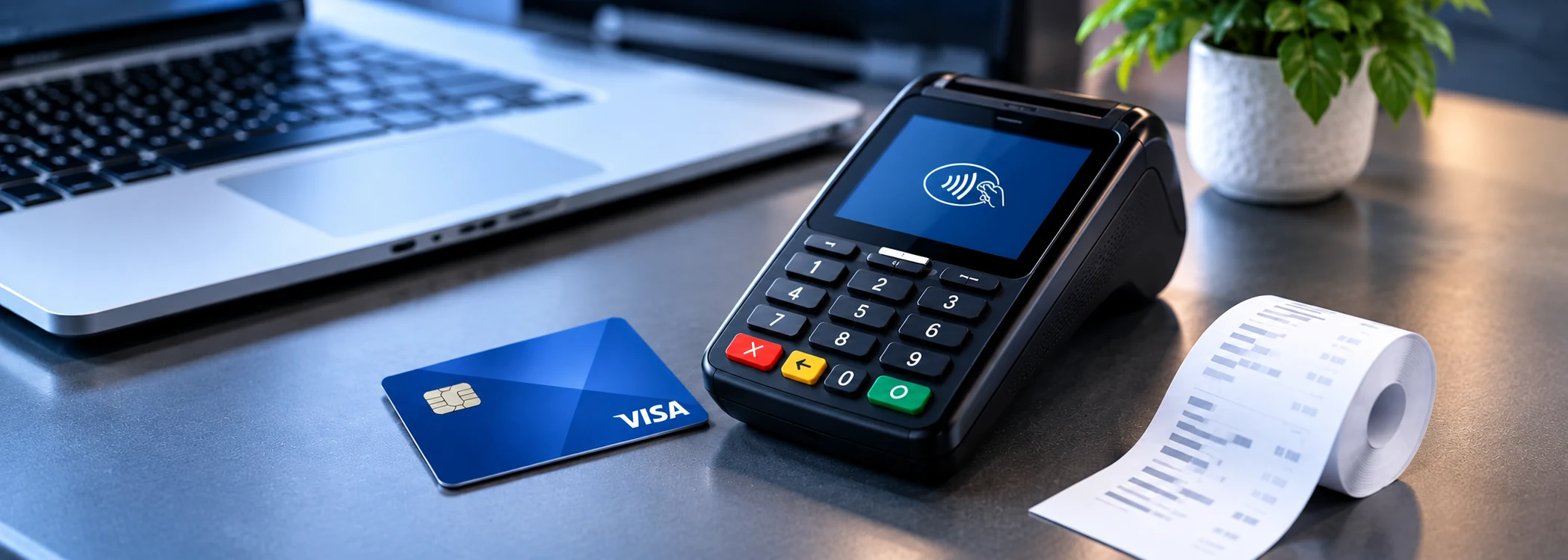
Card payment fees explained

Most card payment costs fall into a few types. Comparing providers means adding these up for your own sales pattern, not just comparing headline rates.

Percentage transaction fee
A share of each payment, for example 1.5% of a €40 sale is 60c. Rates often differ between in-person and online payments, and between cards issued in Europe and elsewhere.
Fixed fee per transaction
A flat amount added to each payment regardless of its size. It is common on online payments and on some in-person pricing.
Card reader or terminal costs
Either a one-off purchase price or an ongoing rental. Accessories such as charging docks, cases and receipt printers can add to the cost.
Monthly or platform fees
Subscription plans, point-of-sale software, online store plans or minimum monthly charges. Some providers charge none on their standard pricing.
Refund and chargeback charges
Some providers keep the original processing fee when you refund. A chargeback, where a customer's bank reverses a payment, can carry a separate fee on top of the lost sale.

For every charge in more detail, including international cards, VAT, payouts and worked monthly examples, read card machine fees in Ireland explained.

Why the lowest rate is not always the lowest cost

An illustrative comparison of two made-up price plans. These are not any provider's rates.

Fee per sale under two illustrative price plans
Sale value Plan A1.4% + 10c Plan B1.75%, no fixed fee
€8 coffee and scone21c14c
€40 retail sale66c70c
€250 trade job€3.60€4.38

Plan A has the lower percentage, but its fixed 10c makes it the more expensive plan on small sales. The two cost the same at about €29; above that, Plan A is cheaper. Lower figures are shown in bold. Add any monthly fee and hardware cost, then multiply by your typical number of sales to compare totals.

Card machines and payment terminals

"Card machine" covers several kinds of device. The right one depends on where you take payments and whether you need a built-in receipt printer, a screen for your staff, or something that fits in a pocket. Our guide to card machines for small businesses covers connectivity, battery life and what different trades need.

  • Countertop terminals

    Fixed at the till and usually connected by cable, Wi-Fi or ethernet. They often print receipts and can link to your point-of-sale system so the amount is sent automatically.

    Often suits Retail shops, pharmacies, salons and busy counters.

  • Portable terminals

    Battery-powered, standalone devices that work anywhere within Wi-Fi range or on a mobile data connection. Staff can bring them to the customer.

    Often suits Cafés, restaurants and pubs with table service.

  • Mobile card readers

    Small, lower-cost readers that pair with a smartphone or tablet app by Bluetooth. The phone handles the connection and the receipt, usually sent by email or text.

    Often suits Market sellers, trades, pop-ups and mobile services.

  • Tap to pay on a phone

    Some providers' apps let a compatible smartphone accept contactless cards and digital wallets directly, with no extra hardware. Supported phones and payment limits vary.

    Often suits Low-volume sellers, tradespeople and anyone starting out.

Taking card payments online

You do not need a full online shop to take card payments remotely. The main options range from a simple link you send to a customer, through to a checkout built into your website. Our guide to online card payments, payment links and virtual terminals explains each option in depth.

Ecommerce checkout
The payment page customers see when they buy from your website. It can be hosted by the provider, with the customer briefly redirected, or embedded directly in your site.
Payment gateways
The service that securely passes card details from your website to the card networks and returns an approval or decline. Many providers combine the gateway and the merchant account in one sign-up.
Payment links and invoices
A secure link for a set amount, sent by email, text or messaging app, lets a customer pay by card with no website needed. Invoicing software can add the same "Pay now" option to invoices and mark them as paid automatically.
Virtual terminals
A screen in your browser where you type in a customer's card details, for example when taking an order by phone. These keyed-in payments often carry a higher rate.
Ecommerce platform integrations
Website builders and shop platforms usually offer built-in payments or plug-ins for particular providers. Check which providers your platform supports before you choose one.
Recurring payments and subscriptions
If you bill customers on a regular basis, check whether the provider supports stored cards, subscription payments and automatic recurring billing.

Card payments for different types of business

  • Retail

    Reliable countertop hardware, a till or point-of-sale integration, stock tracking and fast, dependable payouts. Total cost at your average basket size matters more than the headline rate.

  • Hospitality

    Portable terminals for table service, tipping on the device, splitting bills and strong Wi-Fi or mobile data coverage. Fixed per-transaction fees add up quickly on low-value sales.

  • Trades and mobile businesses

    A reader that works on mobile data, or tap to pay on a phone, plus payment links and invoices for deposits and work completed. Low or no monthly fees suit irregular volumes.

  • Professional services

    Invoices with a card payment option, payment links, and occasionally a virtual terminal for payments by phone. Integration with your accounting software usually matters more than hardware.

  • Ecommerce

    Support for your website platform, a smooth checkout with digital wallets, fraud screening, clear dispute handling, and rates for customers paying with cards issued outside Ireland.

Card payments in Ireland

Card payments are part of everyday trade in Ireland. Central Bank of Ireland payment statistics for 2025 recorded 3.30 billion card payments worth €186.85 billion, with the number of card payments up 9.8% on 2024.

The average domestic card payment in 2025 was €42.69. If your typical sale is around that size, both the percentage rate and any fixed fee per payment affect what you pay, as the fee example above shows.

  • 3.30bn

    card payments in 2025, up 9.8% on 2024

  • €186.85bn

    total value of card payments in 2025

  • €42.69

    average domestic card payment in 2025

Source: Central Bank of Ireland, Payment Statistics, 2025 data.

Card payments: frequently asked questions

How much does it cost to accept card payments in Ireland?

It depends on the provider and on how you take payments. Most charge a percentage of each sale, sometimes with a fixed fee per payment, and rates for online or keyed-in payments are often higher than for in-person ones. Add any hardware and monthly costs to get the full picture. The comparison above shows each provider's published standard rates.

Do I need a merchant account to take card payments?

Not always as a separate step. Traditional bank-based merchant services involve applying for a merchant account with an acquirer. Many newer providers include this in a single sign-up, so you can start accepting payments once they have verified your identity and business details.

Can a sole trader accept card payments?

Yes. Sole traders can generally sign up with card payment providers in the same way as limited companies. Expect to provide identification, details of your business activity and an account for payouts. Check each provider's eligibility requirements before applying.

What is the difference between a card reader and a payment terminal?

A card reader is usually a small device that pairs with a phone or tablet, which runs the app and handles the connection. A payment terminal is a standalone device with its own screen and connection, and often a built-in receipt printer.

Can I take card payments without a card machine?

Yes. You can send payment links, add a card payment option to invoices, take payments through a website checkout or a virtual terminal, or use tap to pay on a compatible smartphone where your provider supports it.

How quickly do card payments reach my bank account?

It varies by provider and can depend on your account history. Standard payouts typically arrive within a few working days, and some providers offer faster payouts, sometimes for a fee. Check the payout schedule and any charges before choosing.

Card payment guides

Practical guides to help you understand card machines, fees and payment options before choosing a provider.

FEATURED GUIDE

How to Accept Card Payments in Ireland

A step-by-step guide to taking card payments in person, online or both, from choosing a provider and getting verified to testing, payouts and keeping costs down.

  • Choosing a provider and completing verification
  • Card machines, Tap to Pay and payment links
  • Testing, payouts, refunds and security
Read the guide: How to Accept Card Payments in Ireland

Compare card payment options for your business

Before you choose, think about how your customers pay, your typical number and value of sales, whether you need a card machine, and whether you sell in person, online or both. Then compare providers on their total cost for your business.

Compare card payment providers

Looking for other business services? Return to the Stuama.ie homepage to compare accounting software, business websites and business insurance.